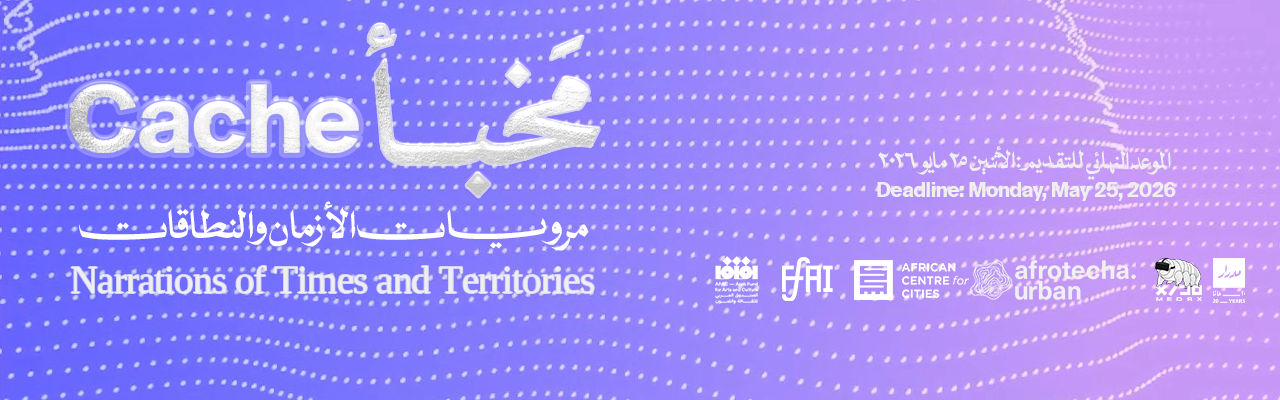
Open Call – Cache: Narrations of Times and Territories
MedRX
Open Call
Medrar for Contemporary Art
6 May 2026 - 31 May 2026
Deadline Extended: Sunday, 31 May, 2026
Application Form link: https://forms.gle/NttSwrU3SLJD4hmx5
FAQ and application guide link: https://drive.google.com/file/d/1ZwxVz_EcrEJwrYPiIMEWh53JUDCtJLh1/view?usp=drive_link
Cache: Narrations of Times and Territories is a six-month program under MedRX Portal, supporting individual practitioners and contributing to the development of artistic research, immersive practices, and new media production.
Launching in June 2026, Cache brings together a Research Lab and a Production Lab running in parallel, each supporting a cohort of 5–8 participants across artistic research, production, dialogue, and shared learning.
Throughout the program, participants receive mentorship and guidance, a participation fee, access to studio space and shared working facilities, technical support and consultation, access to equipment and production resources, workshops, reading sessions, collective discussions, and opportunities for exchange.
The program concludes with an exhibition and publication featuring the works and research developed throughout its duration, alongside public and semi-public presentations and activities across the program.
Conceptual Framework
“Cache” is approached as a metaphor drawn from temporary data storage files that function as memory expected to disappear, be deleted, or overlooked, yet remain partially retained as residue.
The theme is an invitation to think through cache as a carrier of histories, failures, and unrealized possibilities. It may appear as chemical residue, ruins, unformulated citations, lost data, dysfunctional systems, and bodily traces; material and immaterial traces of erasure, transformation, and persistence.
Taking “cache” as both a technological and epistemological condition, the program questions the assumption that new media is weightless, existing only at the interface, the screen, and the seamless experience. It approaches technology as something that shapes our experience while also being shaped by it, while accounting for time, knowledge, and the social and material conditions integral to how we think about contemporary media.
The program falls under Medrar’s MedRX Portal, focusing on practices working across new media and technologically mediated forms, including XR and immersive technologies to develop local knowledge in the field. It strives to bridge the gap between alternative artistic research and production. These components are linked to build a sustainable ecosystem of digital art production and technologies.
“Cache” proposes a set of thematic directions that offer different entry points for applicants to develop their projects. These include:
Conditions of Residue — How can we read the traces left by media, technologies, and different systems as an entry point to understanding their transformations and the marks of their use? What remains after breakdown, interruption, or accumulation? And how can incomplete files, digital and physical traces, and abandoned or dysfunctional structures become material for artistic and research practice?
Knowledge Assembly — How is knowledge formed through fragments, references, incomplete records, and dispersed materials? How can tools, media, and technologies be understood through their artistic, social, and cultural traces? And in what ways can research, writing, image-making, and artistic practice become methods for producing and sharing knowledge?
Speculative Temporalities — How do different temporalities intersect across media, systems, and images? How can working across past, present, and future open space for other narratives and new possibilities around times and territories? This direction looks at our relationship to tools and media, and the residues, files, and memories they leave behind, as points of departure for thinking through time, its experience, and its transformations.
Ideology of the Medium — How can technology be approached beyond its understanding as a means of production, entertainment, or simply a technical tool? How might it be understood as technique and craft carrying material, historical, cultural, and political dimensions? This direction raises questions around use, function, and what technology can make possible when it is used or re-read beyond dominant aesthetic models.
Program Structure
The Research Lab and the Production Lab run in parallel, each with its own track and group of participants, while intersecting at different moments throughout the program through selected sessions, gatherings, and public activities.
Research Lab
The Research Lab is not a conventional classroom setting, but an interactive six-month space that intersects at different moments with the Production Lab. It brings together reading, writing, individual research, collective discussions, field visits, reflection, experimentation.
Who can apply to the research lab?
– Researchers, writers, artists, curators, and cultural practitioners whose work intersects with contemporary art, visual culture, digital and immersive media, and technology.
– Interdisciplinary artistic and research-based practices, especially projects grounded in research, writing, image-making, moving image, digital media, or artistic practices engaged with knowledge production.
– Applicants whose projects engage with questions related to media, technology, memory, archives, image-making, or the material and cultural conditions of tools and media.
Expected outcomes: The Research Lab aims to develop initial ideas into research-based artistic or research outcomes, including texts, research projects, experimental formats, and collective contributions across publications, the public program, or the final exhibition.
Production Lab
The Production Lab departs from the “Cache” as a concept for thinking across intersections of memory, time, temporality, and technology, and how a digital technological concept can operate as a methodology for research through workshops, collective readings, and visits with artists and practitioners.
Who can apply to the Production Lab?
– Artists and practitioners working across new media, experimental, and interdisciplinary artistic practices.
– The lab expects applicants’ proposals and/or previous works to demonstrate an engagement with technology as a production tool or a research subject.
– Prior technical expertise or advanced knowledge of programming languages is not required.
Expected outcomes: The Production Lab aims to develop artistic works and experimental practices engaging with Generative & Interactive systems, Virtual and Augmented Reality (VR & AR), Hyper Mediums, and practices working across sound, image, space, and immersive environments (Immersive Environments).
Curatorial Team: Raneem Elhaddad & Mohamed Abdelkarim
Guests and Contributors:
Dina Jereidini (multidisciplinary artist), Rania Lee Khalil (artist) Shehab Ismail (historian), Shorouk El Hariry (writer and researcher), Mostafa Elbaroody (artist and architect), Mena El Shazly (visual artist), Mohammed Ezzeldin (historian).
Afrotecha.urban: afrotecha.urban is an applied research project at the African Centre for Cities, University of Cape Town. Our transdisciplinary team investigates multiple curiosities of how youth are using technologies in African cities to live, work, play, make, organise, and connect. These curiosities have been applied through collaboratively curated, youth-run, ‘labs-not-labs’* in Cape Town, Durban, Nairobi and Cairo. Each ‘not-lab’ takes on a situated life, exploring key themes in context co-produced with embedded collectives and harnessing what we call amoebic thinking.
afrotecha.cairo foregrounds how Cairo’s youth as early career and emerging artists, tap into residues as entry points, tracing the histories of technology and charting speculative futures in flux. Through the tools of new media and contemporary arts, we surface alternative knowledge on urban materialities between the human and non-human. In the lab we will speculate what occurs through the residual leftover, seen as aftermath interactions with the periphery, and observe possibilities of emergence and renewal.
https://www.africancentreforcities.net/programme/afrotecha-urban/ https://www.africancentreforcities.net/
Further contributors will be invited throughout the program in response to the specific needs and practices of the participants.
Eligibility
– Early-career Egyptian and Arab artists, writers, researchers, and cultural practitioners with an active independent practice (typically 2–10 years).
– Applicants must be based in Cairo during the application and program period.
– Selection is based on the proposal’s relevance to the program themes and the clarity of the applicant’s approach.
– Prior technical experience is not required, though familiarity with relevant tools, media, or methodologies is encouraged.
– Working languages: Arabic and English.
Timeline
– Application deadline: Monday, 25 May 2026, 11:59 PM Cairo time
– Interviews: first week of June 2026
– Results announcement: second week of June 2026
– Program duration: June – December 2026
– Final presentation: January – February 2027
Commitment/ requirements
– Access to personal equipment or tools necessary for working throughout the program.
– Commitment to the full program duration and regular attendance (approx. 1–2 days weekly).
– Development of a proposed or ongoing long-term project within the program framework.
– Contribution to public activities engaging with research and practice.
– Participation in public activities and the final collective exhibition in early 2027.
This project is supported by the Arab Fund for Arts and Culture (AFAC) and the Foundation for Arts Initiatives (FFAI).